 Chromium Code Reviews Chromium Code Reviews
 Issue 2636213003:
Separate layout test docs stating facts from guidelines. (Closed)
Issue 2636213003:
Separate layout test docs stating facts from guidelines. (Closed)
| Index: docs/testing/writing_layout_tests.md |
| diff --git a/docs/testing/writing_layout_tests.md b/docs/testing/writing_layout_tests.md |
| index 37e5e2ab7afa861739aaf50c766437d173b43780..ed11fedc18ae815a523af0eabe8b5d7bc752034a 100644 |
| --- a/docs/testing/writing_layout_tests.md |
| +++ b/docs/testing/writing_layout_tests.md |
| @@ -68,246 +68,24 @@ There are four broad types of layout tests, listed in the order of preference. |
| Layout tree tests are used as a last resort to test the internal quirks of |
| the implementation, and they should be avoided in favor of one of the earlier |
| options. |
| -## General Principles |
| - |
| -The principles below are adapted from |
| -[Test the Web Forward's Test Format Guidelines](http://testthewebforward.org/docs/test-format-guidelines.html) |
| -and |
| -[WebKit's Wiki page on Writing good test cases](https://trac.webkit.org/wiki/Writing%20Layout%20Tests%20for%20DumpRenderTree). |
| - |
| -*** note |
| -This document intentionally uses _should_ a lot more than _must_, as defined in |
| -[RFC 2119](https://www.ietf.org/rfc/rfc2119.txt). Writing layout tests is a |
| -careful act of balancing many concerns, and this humble document cannot possibly |
| -capture the context that rests in the head of an experienced Blink engineer. |
| -*** |
| - |
| -### Concise |
| - |
| -Tests should be **concise**, without compromising on the principles below. Every |
| -element and piece of code on the page should be necessary and relevant to what |
| -is being tested. For example, don't build a fully functional signup form if you |
| -only need a text field or a button. |
| - |
| -Content needed to satisfy the principles below is considered necessary. For |
| -example, it is acceptable and desirable to add elements that make the test |
| -self-describing (see below), and to add code that makes the test more reliable |
| -(see below). |
| - |
| -Content that makes test failures easier to debug is considered necessary (to |
| -maintaining a good development speed), and is both acceptable and desirable. |
| - |
| -*** promo |
| -Conciseness is particularly important for reference tests and pixel tests, as |
| -the test pages are rendered in an 800x600px viewport. Having content outside the |
| -viewport is undesirable because the outside content does not get compared, and |
| -because the resulting scrollbars are platform-specific UI widgets, making the |
| -test results less reliable. |
| -*** |
| - |
| -### Fast |
| - |
| -Tests should be as **fast** as possible, without compromising on the principles |
| -below. Blink has several thousand layout tests that are run in parallel, and |
| -avoiding unnecessary delays is crucial to keeping our Commit Queue in good |
| -shape. |
| - |
| -Avoid |
| -[window.setTimeout](https://developer.mozilla.org/en-US/docs/Web/API/WindowTimers/setTimeout), |
| -as it wastes time on the testing infrastructure. Instead, use specific event |
| -handlers, such as |
| -[window.onload](https://developer.mozilla.org/en-US/docs/Web/API/GlobalEventHandlers/onload), |
| -to decide when to advance to the next step in a test. |
| - |
| -### Reliable |
| - |
| -Tests should be **reliable** and yield consistent results for a given |
| -implementation. Flaky tests slow down your fellow developers' debugging efforts |
| -and the Commit Queue. |
| - |
| -`window.setTimeout` is again a primary offender here. Asides from wasting time |
| -on a fast system, tests that rely on fixed timeouts can fail when on systems |
| -that are slower than expected. |
| - |
| -Follow the guidelines in this |
| -[PSA on writing reliable layout tests](https://docs.google.com/document/d/1Yl4SnTLBWmY1O99_BTtQvuoffP8YM9HZx2YPkEsaduQ/edit). |
| - |
| -### Self-Describing |
| - |
| -Tests should be **self-describing**, so that a project member can recognize |
| -whether a test passes or fails without having to read the specification of the |
| -feature being tested. `testharness.js` makes a test self-describing when used |
| -correctly, but tests that degrade to manual tests |
| -[must be carefully designed](http://testthewebforward.org/docs/test-style-guidelines.html) |
| -to be self-describing. |
| - |
| -### Minimal |
| - |
| -Tests should require a **minimal** amount of cognitive effort to read and |
| -maintain. |
| -Avoid depending on edge case behavior of features that aren't explicitly covered |
| -by the test. For example, except where testing parsing, tests should contain |
| -valid markup (no parsing errors). |
| - |
| -Tests should provide as much relevant information as possible when failing. |
| -`testharness.js` tests should prefer |
| -[rich assert_ functions](https://github.com/w3c/testharness.js/blob/master/docs/api.md#list-of-assertions) |
| -to combining `assert_true()` with a boolean operator. Using appropriate |
| -`assert_` functions results in better diagnostic output when the assertion |
| -fails. |
| - |
| -🚧 Prefer JavaScript's |
| -[===](https://developer.mozilla.org/docs/Web/JavaScript/Reference/Operators/Comparison_Operators#Identity_strict_equality_()) |
| -operator to |
| -[==](https://developer.mozilla.org/docs/Web/JavaScript/Reference/Operators/Comparison_Operators#Equality_()) |
| -so that readers don't have to reason about |
| -[type conversion](http://www.ecma-international.org/ecma-262/6.0/#sec-abstract-equality-comparison). |
| - |
| -*** promo |
| -The === vs == recommendation is still being discussed on |
| -[blink-dev](https://groups.google.com/a/chromium.org/d/topic/blink-dev/XsR6PKRrS1E/discussion). |
| -However, please keep in mind that a fellow developer who has to debug a failing |
| -test may have to consider the |
| -[special cases for ==](http://dorey.github.io/JavaScript-Equality-Table/) when |
| -the types of the two values being compared aren't immediately obvious. |
| -*** |
| - |
| -### Cross-Platform |
| - |
| -Tests should be as **cross-platform** as reasonably possible. Avoid assumptions |
| -about device type, screen resolution, etc. Unavoidable assumptions should be |
| -documented. |
| - |
| -When possible, tests should only use Web platform features, as specified |
| -in the relevant standards. When the Web platform's APIs are insufficient, |
| -tests should prefer to use WPT extended testing APIs, such as |
| -`wpt_automation`, over Blink-specific testing APIs. |
| - |
| -🚧 Tests that use testing APIs should feature-test for the presence of |
| -those APIs, and gracefully degrade to manual tests (see below) when the testing |
| -APIs are not available. |
| +## General Principles |
| -Test pages should use the HTML5 doctype (`<!doctype html>`) unless they |
| -specifically cover |
| -[quirks mode](https://developer.mozilla.org/docs/Quirks_Mode_and_Standards_Mode) |
| -behavior. |
| Tests should be written under the assumption that they will be upstreamed |
| -to the WPT project. For example, tests should follow the |
| +to the WPT project. To this end, tests should follow the |
| [WPT guidelines](http://testthewebforward.org/docs/writing-tests.html). |
| -Tests should avoid using features that haven't been shipped by the |
| -actively-developed major rendering engines (Blink, WebKit, Gecko, Edge). When |
| -unsure, check [caniuse.com](http://caniuse.com/). By necessity, this |
| -recommendation does not apply to the feature targeted by the test. |
| - |
| -*** note |
| -It may be tempting have a test for a bleeding-edge feature X depend on feature |
| -Y, which has only shipped in beta / development versions of various browsers. |
| -The reasoning would be that all browsers that implement X will have implemented |
| -Y. Please keep in mind that Chrome has un-shipped features that made it to the |
| -Beta channel in the past. |
| -*** |
| - |
| -Tests that use Blink-specific testing APIs should feature-test for the |
| -presence of the testing APIs and degrade to |
| -[manual tests](http://testthewebforward.org/docs/manual-test.html) when |
| -the testing APIs are not present. |
| - |
| -*** promo |
| -The recommendation to degrade to manual tests is still being discussed on |
| -[blink-dev](https://groups.google.com/a/chromium.org/d/topic/blink-dev/XsR6PKRrS1E/discussion). |
| -However, please keep in mind that a manual test can be debugged in the browser, |
| -whereas a test that does not degrade gracefully can only be debugged in the test |
| -runner. Fellow project members and future you will thank you for having your |
| -test work as a manual test. |
| -*** |
| - |
| -### Self-Contained |
| - |
| -Tests must be **self-contained** and not depend on external network resources. |
| - |
| -Unless used by multiple test files, CSS and JavaScript should be inlined using |
| -`<style>` and `<script>` tags. Content shared by multiple tests should be |
| -placed in a `resources/` directory near the tests that share it. See below for |
| -using multiple origins in a test. |
| - |
| -### File Names |
| - |
| -Test **file names** should describe what is being tested. |
| -File names should use `snake-case`, but preserve the case of any embedded API |
| -names. For example, prefer `document-createElement.html` to |
| -`document-create-element.html`. |
| +There is no style guide that applies to all layout tests. However, some projects |
| +have adopted style guides, such as the |
| +[ServiceWorker Tests Style guide](https://www.chromium.org/blink/serviceworker/testing). |
| -### Modern Features |
| - |
| -Tests should prefer **modern features** in JavaScript and in the Web Platform, |
| -provided that they meet the recommendations above for cross-platform tests. |
| - |
| -Tests should use |
| -[strict mode](https://developer.mozilla.org/en-US/docs/Web/JavaScript/Reference/Strict_mode) |
| -for all JavaScript, except when specifically testing sloppy mode behavior. |
| -Strict mode flags deprecated features and helps catch some errors, such as |
| -forgetting to declare variables. |
| - |
| -🚧 JavaScript code should prefer |
| -[const](https://developer.mozilla.org/docs/Web/JavaScript/Reference/Statements/const) |
| -and |
| -[let](https://developer.mozilla.org/docs/Web/JavaScript/Reference/Statements/let) |
| -over `var`, |
| -[classes](https://developer.mozilla.org/docs/Web/JavaScript/Reference/Classes) |
| -over other OOP constructs, and |
| -[Promises](https://developer.mozilla.org/docs/Web/JavaScript/Reference/Global_Objects/Promise) |
| -over other mechanisms for structuring asynchronous code. |
| - |
| -*** promo |
| -The recommendation to prefer `const` and `let` over `var` is currently being |
| -discussed on |
| -[blink-dev](https://groups.google.com/a/chromium.org/d/topic/blink-dev/XsR6PKRrS1E/discussion). |
| -*** |
| - |
| -### Character Encoding |
| - |
| -🚧 Tests should use the UTF-8 **character encoding**, which should be |
| -declared by `<meta charset=utf-8>`. This does not apply when specifically |
| -testing encodings. |
| - |
| -The `<meta>` tag must be the first child of the document's `<head>` element. In |
| -documents that do not have an explicit `<head>`, the `<meta>` tag must follow |
| -the doctype. |
| - |
| -When HTML pages do not explicitly declare a character encoding, browsers |
| -determine the encoding using an |
| -[encoding sniffing algorithm](https://html.spec.whatwg.org/multipage/syntax.html#determining-the-character-encoding) |
| -that will surprise most modern Web developers. Highlights include a default |
| -encoding that depends on the user's locale, and non-standardized |
| -browser-specific heuristics. |
| - |
| -*** promo |
| -The WPT guidelines state that test files that only contain ASCII characters may |
| -omit the `<meta>` tag. This exception is currently discussed on |
| -[blink-dev](https://groups.google.com/a/chromium.org/d/topic/blink-dev/XsR6PKRrS1E/discussion). |
| -If taking that route, please keep in mind that Firefox currently issues a |
| -[development tools](https://developer.mozilla.org/en-US/docs/Tools) warning for |
| -pages without a declared encoding. |
| -*** |
| - |
| -### Coding Style |
| - |
| -Tests should aim to have a **coding style** that is consistent with |
| -[Google's JavaScript Style Guide](https://google.github.io/styleguide/jsguide.html), |
| -and |
| -[Google's HTML/CSS Style Guide](https://google.github.io/styleguide/htmlcssguide.xml), |
| -with the following exceptions. |
| - |
| -* Rules related to Google Closure and JSDoc do not apply. |
| -* Modern Web Platform and JavaScript features should be preferred to legacy |
| - constructs that target old browsers. |
| -* Per the JavaScript guide, new tests should also follow any per-project |
| - style guide, such as the |
| - [ServiceWorker Tests Style guide](https://www.chromium.org/blink/serviceworker/testing). |
| +Our [document on layout tests tips](./layout_tests_tips.md) summarizes the most |
| +important WPT guidelines and highlights some JavaScript concepts that are worth |
| +paying attention to when trying to infer style rules from existing tests. If |
| +you're unopinionated and looking for a style guide to follow, the document also |
| +suggests some defaults. |
| ## JavaScript Tests |
| @@ -375,6 +153,9 @@ promise_test(() => { |
| Some points that are not immediately obvious from the example: |
| +* This example only uses ASCII characters, so `<meta charset="utf-8">` is not |
| + strictly necessary. The `<meta charset>` is always allowed though, so you |
| + can't go wrong by having it in! |
| * The `<meta name="assert">` describes the purpose of the entire file, and |
|
jsbell
2017/01/20 19:25:21
This is awkward. ".. is not redundant to title" bu
pwnall
2017/01/21 01:15:50
Done.
Thinking back, I don't recall having used it
|
| is not redundant to `<title>`. Don't add a `<meta name="assert">` when the |
| information in the `<title>` is sufficient. |
| @@ -428,6 +209,11 @@ some tests that require a user to perform a gesture, such as a mouse click, |
| cannot be implemented using Web APIs. The WPT project covers some of these cases |
| via supplemental testing APIs. |
| +When writing tests that rely on supplemental testing APIs, please consider the |
| +cost and benefits of having the tests |
| +[gracefully degrade to manual tests](./layout_tests_with_manual_fallback.md) in |
| +the absence of the testing APIs. |
| + |
| *** promo |
| In many cases, the user gesture is not actually necessary. For example, many |
| event handling tests can use |
| @@ -488,98 +274,6 @@ Here is a UML diagram of how the `testRunner` bindings fit into Chromium. |
| [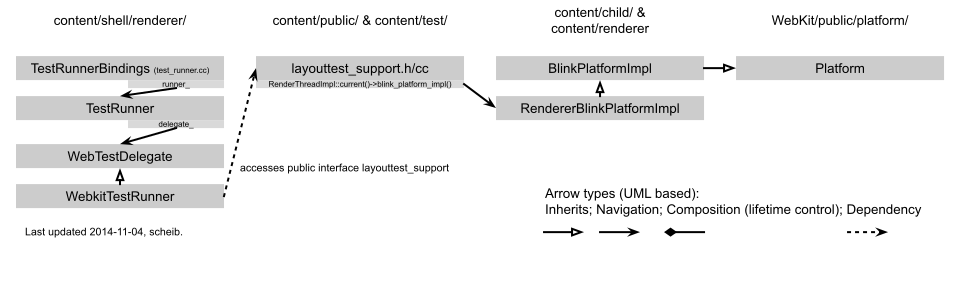](https://docs.google.com/drawings/d/1KNRNjlxK0Q3Tp8rKxuuM5mpWf4OJQZmvm9_kpwu_Wwg/edit) |
| -### Manual Tests |
| - |
| -🚧 Whenever possible, tests that rely on (WPT's or Blink's) testing APIs |
| -should also be usable as |
| -[manual tests](http://testthewebforward.org/docs/manual-test.html). This makes |
| -it easy to debug the test, and to check whether our behavior matches other |
| -browsers. |
| - |
| -*** promo |
| -The recommendation to degrade to manual tests is still being discussed on |
| -[blink-dev](https://groups.google.com/a/chromium.org/d/topic/blink-dev/XsR6PKRrS1E/discussion). |
| -However, please keep in mind that a manual test can be debugged in the browser, |
| -whereas a test that does not degrade gracefully can only be debugged in the test |
| -runner. Fellow project members and future you will thank you for having your |
| -test work as a manual test. |
| -*** |
| - |
| -Manual tests should minimize the chance of user error. This implies keeping the |
| -manual steps to a minimum, and having simple and clear instructions that |
| -describe all the configuration changes and user gestures that match the effect |
| -of the Blink-specific APIs used by the test. |
| - |
| -Below is an example of a fairly minimal test that uses a Blink-Specific API |
| -(`window.eventSender`), and gracefully degrades to a manual test. |
| - |
| -```html |
| -<!doctype html> |
| -<meta charset="utf-8"> |
| -<title>DOM: Event.isTrusted for UI events</title> |
| -<link rel="help" href="https://dom.spec.whatwg.org/#dom-event-istrusted"> |
| -<link rel="help" href="https://dom.spec.whatwg.org/#constructing-events"> |
| -<meta name="assert" |
| - content="Event.isTrusted is true for events generated by user interaction"> |
| -<script src="../../resources/testharness.js"></script> |
| -<script src="../../resources/testharnessreport.js"></script> |
| - |
| -<p>Please click on the button below.</p> |
| -<button>Click Me!</button> |
| - |
| -<script> |
| -'use strict'; |
| - |
| -setup({ explicit_timeout: true }); |
| - |
| -promise_test(() => { |
| - const button = document.querySelector('button'); |
| - return new Promise((resolve, reject) => { |
| - const button = document.querySelector('button'); |
| - button.addEventListener('click', (event) => { |
| - resolve(event); |
| - }); |
| - |
| - if (window.eventSender) { |
| - eventSender.mouseMoveTo(button.offsetLeft, button.offsetTop); |
| - eventSender.mouseDown(); |
| - eventSender.mouseUp(); |
| - } |
| - }).then((clickEvent) => { |
| - assert_true(clickEvent.isTrusted); |
| - }); |
| - |
| -}, 'Click generated by user interaction'); |
| - |
| -</script> |
| -``` |
| - |
| -The test exhibits the following desirable features: |
| - |
| -* It has a second specification URL (`<link rel="help">`), because the paragraph |
| - that documents the tested feature (referenced by the primary URL) is not very |
| - informative on its own. |
| -* It links to the |
| - [WHATWG Living Standard](https://wiki.whatwg.org/wiki/FAQ#What_does_.22Living_Standard.22_mean.3F), |
| - rather than to a frozen version of the specification. |
| -* It contains clear instructions for manually triggering the test conditions. |
| - The test starts with a paragraph (`<p>`) that tells the tester exactly what to |
| - do, and the `<button>` that needs to be clicked is clearly labeled. |
| -* It disables the timeout mechanism built into `testharness.js` by calling |
| - `setup({ explicit_timeout: true });` |
| -* It checks for the presence of the Blink-specific testing APIs |
| - (`window.eventSender`) before invoking them. The test does not automatically |
| - fail when the APIs are not present. |
| -* It uses [Promises](https://developer.mozilla.org/docs/Web/JavaScript/Reference/Global_Objects/Promise) |
| - to separate the test setup from the assertions. This is particularly helpful |
| - for manual tests that depend on a sequence of events to occur, as Promises |
| - offer a composable way to express waiting for asynchronous events that avoids |
| - [callback hell](http://stackabuse.com/avoiding-callback-hell-in-node-js/). |
| - |
| -Notice that the test is pretty heavy compared to a minimal JavaScript test that |
| -does not rely on testing APIs. Only use testing APIs when the desired testing |
| -conditions cannot be set up using Web Platform APIs. |
| - |
| ### Text Test Baselines |
| By default, all the test cases in a file that uses `testharness.js` are expected |
