 Chromium Code Reviews Chromium Code Reviews
 Issue 2492733003:
New documentation on writing LayoutTests. (Closed)
Issue 2492733003:
New documentation on writing LayoutTests. (Closed)
| Index: docs/testing/layout_test_writing.md |
| diff --git a/docs/testing/layout_test_writing.md b/docs/testing/layout_test_writing.md |
| new file mode 100644 |
| index 0000000000000000000000000000000000000000..ce541f83764fea7b035fc452ac0f9e2cd2fc6677 |
| --- /dev/null |
| +++ b/docs/testing/layout_test_writing.md |
| @@ -0,0 +1,299 @@ |
| +# Writing Layout Tests |
| + |
| +_Layout tests_ is a bit of a misnomer. This term is |
| +[a part of our WebKit heritage](https://webkit.org/blog/1452/layout-tests-theory/), |
| +and we use it to refer to every test that is written as an HTML page and lives |
|
jsbell
2016/11/10 19:32:26
We have some ref tests that are SVG documents, as
pwnall
2016/11/11 20:51:07
Done.
Added mentions to XHTML and SVG. Let's deal
|
| +in [third_party/WebKit/LayoutTests/](../../third_party/WebKit/LayoutTests). |
| + |
| +Layout tests should be used to accomplish one of the following goals: |
| + |
| +1. The entire surface of Blink that is exposed to the Web should be covered by |
| + tests that we contribute to the |
| + [Web Platform Tests Project](https://github.com/w3c/web-platform-tests) |
| + (WPT). This helps us avoid regressions, and gives us confidence that we match |
| + other browsers' behavior. |
| +2. When a Blink feature cannot be tested using the Web Platform, and cannot be |
| + easily covered by |
| + [C++ unit tests](https://cs.chromium.org/chromium/src/third_party/WebKit/Source/web/tests/?q=webframetest&sq=package:chromium&type=cs), |
| + the feature must be covered by layout tests, to avoid unexpected regressions. |
| + These tests will use Blink-specific testing APIs that are only available in |
| + [content_shell](./layout_tests_in_content_shell.md). |
| + |
| +## General Principles |
| + |
| +The principles below are adapted from |
| +[Test the Web Forward's Test Format Guidelines](http://testthewebforward.org/docs/test-format-guidelines.html) |
| +and |
| +[WebKit's Wiki page on Writing good test cases](https://trac.webkit.org/wiki/Writing%20Layout%20Tests%20for%20DumpRenderTree). |
| + |
| +* Tests should be as **short** as possible. The page should only include |
| + elements that are necessary and relevant to what is being tested. |
| + |
| +* Tests should be as **fast** as possible. Blink has several thousand layout |
| + tests that are run in parallel, and avoiding unnecessary delays is crucial to |
| + keeping our Commit Queue in good shape. Avoid [window.setTimeout](https://developer.mozilla.org/en-US/docs/Web/API/WindowTimers/setTimeout), |
| + as it wastes testing time and can introduce flakiness. Instead, use specific |
| + event handlers, such as |
| + [window.onload](https://developer.mozilla.org/en-US/docs/Web/API/GlobalEventHandlers/onload). |
| + |
| +* Tests should be **self-describing**, so that a project member can recognize |
| + whether a test passes or fails without having to read the specification of the |
| + feature being tested. `testharness.js` makes a test self-describing when used |
| + correctly, but tests that degrade to manual tests |
| + [must be carefully designed](http://testthewebforward.org/docs/test-style-guidelines.html) |
| + to be self-describing. |
| + |
| +* Tests should use the **minimal** set of platform features needed to express |
| + the test scenario efficiently. Avoid depending on edge case behavior of |
| + features that aren't explicitly covered by the test. For example, except where |
| + testing parsing, tests should contain no parse errors. |
| + |
| +* Tests should be as **cross-platform** as reasonably possible. Avoid |
| + assumptions about device type, screen resolution, etc. Unavoidable assumptions |
| + should be documented. |
| + * When possible, tests should only use Web platform features, as specified |
| + in the relevant standards. |
| + * Tests should be written under the assumption that they will be upstreamed |
| + to the WPT project. For example, tests should follow the |
| + [WPT guidelines](http://testthewebforward.org/docs/writing-tests.html). |
| + * Tests that use Blink-specific testing APIs should feature-test for the |
| + presence of the testing APIs and degrade to |
| + [manual tests](http://testthewebforward.org/docs/manual-test.html) |
| + when the testing APIs are not present. |
| + |
| +* Tests must be **self-contained** and not depend on external network resources. |
| + Unless used by multiple test files, CSS and JavaScript should be inlined using |
| + `<style>` and `<script>` tags. Content shared by multiple tests should be |
| + placed in a `resources/` directory near the tests that share it. See below for |
| + using multiple origins in a test. |
| + |
| +* Test **file names** should describe what is being tested. |
| + |
| +* Tests must stick to pure ASCII or use the UTF-8 **character encoding**, which |
| + should be declared by `<meta charset=utf-8>`. This does not apply when |
| + specifically testing encodings. |
| + |
| +* Tests must aim to have a **coding style** that is consistent with |
| + [Google's JavaScript Style Guide](https://google.github.io/styleguide/javascriptguide.xml), |
| + with the following exceptions. |
| + * Rules related to Google Closure and JSDoc do not apply. |
| + * Modern Web Platform and JavaScript features should be preferred to legacy |
| + constructs that target old browsers. For example, prefer `const` and `let` |
| + to `var`, and prefer `class` over other OOP constructs. |
| + * Concerns regarding buggy behavior in legacy browsers do not apply. For |
| + example, the garbage collection cycle note in the _Closures_ section does |
| + not apply. |
| + |
| +## JavaScript Tests |
| + |
| +Whenever possible, the testing criteria should be expressed in JavaScript. The |
| +alternatives, which will be described in future sections, result in slower and |
| +less robust tests. |
| + |
| +All new JavaScript tests should be written using the |
| +[testharness.js](https://github.com/w3c/testharness.js/) testing framework. This |
| +framework is used by the tests in the |
| +[web-platform-tests](https://github.com/w3c/web-platform-tests) repository, |
| +which is shared with all the other browser vendors, so `testharness.js` tests |
| +are more accessible to browser developers. |
| + |
| +As a shared framework, `testharness.js` enjoys high-quality documentation, such |
| +as [a tutorial](http://testthewebforward.org/docs/testharness-tutorial.html) and |
| +[API documentation](https://github.com/w3c/testharness.js/blob/master/docs/api.md). |
| +Layout tests should follow the recommendations of the above documents. |
| +Furthermore, layout tests should include relevant |
| +[metadata](http://testthewebforward.org/docs/css-metadata.html). The |
| +specification URL (in `<link rel="help">`) is almost always relevant, and is |
| +incredibly helpful to a developer who needs to understand the test quickly. |
| + |
| +Below is a skeleton for a JavaScript test. Note that, in order to follow the |
|
jsbell
2016/11/10 19:32:25
I think we should give an async_test and promise_t
pwnall
2016/11/11 20:51:07
Done.
|
| +minimality guideline, the test omits the tags `<html>`, `<head>` and `<body>`, |
| +as they can be inferred by the HTML5 parser. |
| + |
| +```html |
| +<!DOCTYPE html> |
| +<meta charset="utf-8"> |
| +<title>JavaScript core: True is truthy</title> |
| +<link rel="help" |
| + href="http://www.ecma-international.org/ecma-262/6.0/#sec-terms-and-definitions-boolean-value"> |
| +<script src="/resources/testharness.js"></script> |
| +<script src="/resources/testharnessreport.js"></script> |
| +<script> |
| +test(t => { |
| + var x = true; |
| + assert_true(x); |
| +}, 'True is truthy.'); |
| +</script> |
| +``` |
| + |
| +### Blink-Specific Testing APIs |
| + |
| +Tests that cannot be expressed using the Web Platform APIs rely on |
| +Blink-specific testing APIs. These APIs are only available in |
| +[content_shell](./layout_tests_in_content_shell.md). |
| + |
| +Whenever possible, tests that rely on Blink-specific testing APIs should also be |
| +usable as [manual tests](http://testthewebforward.org/docs/manual-test.html). |
| +This makes it easy to debug the test, and to check whether our behavior matches |
| +other browsers. |
| + |
| +Manual tests should minimize the chance of user error. This implies keeping the |
|
jsbell
2016/11/10 19:32:26
We may want an inline example here of a "manual" t
pwnall
2016/11/11 20:51:07
Done.
|
| +manual steps to a minimum, and having simple and clear instructions that |
| +describe all the configuration changes and user gestures that match the effect |
| +of the Blink-specific APIs used by the test. |
| + |
| +A downside of Blink-specific APIs is that they are not as well documented as the |
| +Web Platform features. Learning to use a Blink-specific feature requires finding |
| +other tests that use it, or reading its source code. |
| + |
| +For example, the most popular Blink-specific API is `testRunner`, which is |
|
jsbell
2016/11/10 19:32:26
We maybe want to mention (here or above) that test
pwnall
2016/11/11 20:51:07
Done.
I added a note.
|
| +implemented in |
| +[components/test_runner/test_runner.h](../../components/test_runner/test_runner.h) |
| +and |
| +[components/test_runner/test_runner.cpp](../../components/test_runner/test_runner.cpp). |
| +By skimming the `TestRunnerBindings::Install` method, we learn that the |
| +testRunner API is presented by the `window.testRunner` and |
| +`window.layoutTestsController` objects, which are synonyms. Reading the |
| +`TestRunnerBindings::GetObjectTemplateBuilder` method tells us what properties |
| +are available on the `window.testRunner` object. |
| + |
| +*** aside |
| +`window.testRunner` is the preferred way to access the `testRunner` APIs. |
| +`window.layoutTestsController` is still supported because it is used by |
| +3rd-party tests. |
| +*** |
| + |
| +See the [components/test_runner/](../../components/test_runner/) directory and |
| +[WebKit's LayoutTests guide](https://trac.webkit.org/wiki/Writing%20Layout%20Tests%20for%20DumpRenderTree) |
| +for other useful APIs. For example, `window.eventSender` |
| +([components/test_runner/event_sender.h](../../components/test_runner/event_sender.h) |
| +and |
| +[components/test_runner/event_sender.cpp](../../components/test_runner/event_sender.cpp)) |
| +has methods that simulate events input such as keyboard / mouse input and |
| +drag-and-drop. |
| + |
| +Here is a UML diagram of how the `testRunner` bindings fit into Chromium. |
| + |
| +[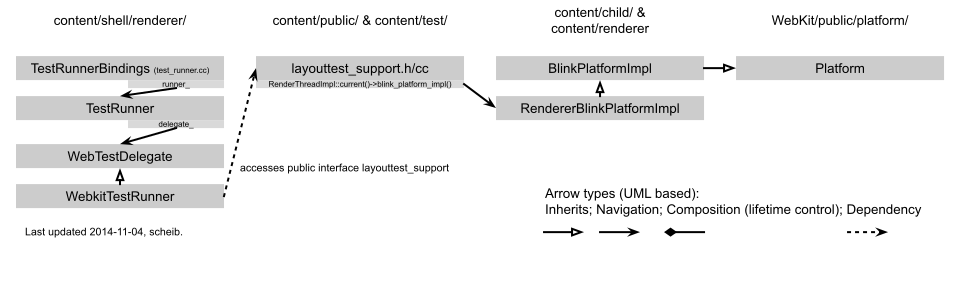](https://docs.google.com/drawings/d/1KNRNjlxK0Q3Tp8rKxuuM5mpWf4OJQZmvm9_kpwu_Wwg/edit) |
| + |
| +### Text Test Expectations |
| + |
| +By default, all the test cases in a file that uses `testharness.js` are expected |
| +to pass. However, in some cases, we prefer to add failing test cases to the |
| +repository, so that we can be notified when the failure modes change. In these |
|
jsbell
2016/11/10 19:32:26
maybe: (e.g. a test starts crashing rather than re
pwnall
2016/11/11 20:51:07
Done.
|
| +situations, a test file will be accompanied by an `-expected.txt` file, which |
| +documents the test's expected output. |
| + |
| +The `-expected.txt` files are generated automatically when appropriate by |
| +`run-webkit-tests`, which is described [here](./layout_tests.md), and by the |
| +[rebaselining tools](./layout_test_expectations.md). |
| + |
| +`-expected.txt` files should be very rare. In general, layout tests should |
| +use JavaScript to document Blink's current behavior, rather than using |
| +JavaScript to document desired behavior and a text file to document current |
| +behavior. |
| + |
| +### js-test tests |
| + |
| +*** promo |
| +For historical reasons, older tests are written using the `js-test` harness. |
| +This harness is **deprecated**, and should not be used for new tests. |
| +*** |
| + |
| +If you need to understand old tests, the best `js-test` documentation is its |
| +implementation at |
| +[third_party/WebKit/LayoutTests/resources/js-test.js](../../third_party/WebKit/LayoutTests/resources/js-test.js). |
| + |
| +`js-test` tests lean heavily on the Blink-specific `testRunner` testing APIs, |
| +which will be fully described below. In a nutshell, the tests call |
| +`testRunner.dumpAsText()` to signal that the page content should be dumped and |
| +compared against an `-expected.txt` file. As a consequence, `js-test` tests are |
| +always accompanied by an `-expected.txt`. Asynchronous tests also use |
| +`testRunner.waitUntilDone()` and `testRunner.notifyDone()` to tell the testing |
| +tools when they are complete. |
| + |
| +### Tests that use an HTTP Server |
|
jsbell
2016/11/10 19:32:25
Should probably have a section about imported test
pwnall
2016/11/11 20:51:07
There is a TODO at the end about documenting wptse
jsbell
2016/11/14 19:12:22
Punting is fine, I just missed the TODO. Thanks!
|
| + |
| +By default, tests are loaded as if via `file:` URLs. Some web platform features |
| +require tests served via HTTP or HTTPS, for example relative paths (`src=/foo`) |
|
jsbell
2016/11/10 19:32:26
absolute paths
(relative paths work file with fil
pwnall
2016/11/11 20:51:07
Done.
|
| +or features restricted to secure protocols. |
| + |
| +HTTP tests are those tests that are under `LayoutTests/http/tests` (or virtual |
| +variants). Use a locally running HTTP server (Apache) to run them. Tests are |
| +served off of ports 8000 and 8080 for HTTP, and 8443 for HTTPS. If you run the |
| +tests using `run-webkit-tests`, the server will be started automatically. To run |
| +the server manually to reproduce or debug a failure: |
| + |
| +```bash |
| +cd src/third_party/WebKit/Tools/Scripts |
| +run-blink-httpd start |
| +``` |
| + |
| +The layout tests will be served from `http://127.0.0.1:8000`. For example, to |
| +run the test `http/tests/serviceworker/chromium/service-worker-allowed.html`, |
| +navigate to |
| +`http://127.0.0.1:8000/serviceworker/chromium/service-worker-allowed.html`. Some |
| +tests will behave differently if you go to 127.0.0.1 instead of localhost, so |
| +use 127.0.0.1. |
| + |
| +To kill the server, run `run-blink-httpd --server stop`, or just use `taskkill` |
| +or the Task Manager on Windows, and `killall` or Activity Monitor on MacOS. |
| + |
| +The test server sets up an alias to `LayoutTests/resources` directory. In HTTP |
| +tests, you can access the testing framework at e.g. |
| +`src="/js-test-resources/js-test.js"`. |
| + |
| +TODO: Document [wptserve](http://wptserve.readthedocs.io/) when we are in a |
| +position to use it to run layout tests. |
| + |
| +## Reference Tests |
| + |
| +TODO: Check that we match the Web Platform's |
| +[reftests](http://testthewebforward.org/docs/reftests.html), link to their |
| +document and summarize it. |
| + |
| +## Pixel Tests |
| + |
| +`testRunner` APIs such as `window.testRunner.dumpAsTextWithPixelResults()` and |
| +`window.testRunner.dumpDragImage()` create an image expectation, turning the |
| +test into a **pixel test**. These tests have associated `-expected.png` image |
| +files. |
| + |
| +Pixel tests are less robust than JavaScript tests and reference tests, because |
| +the browser's image output can be influenced by many factors such as the |
| +graphics driver, the platform's text rendering system, and various |
| +user-configurable platform settings. For this reason, pixel tests should only be |
| +used as a last resort. |
| + |
| +Pixel tests should still follow the |
| +[WPT guidelines](http://testthewebforward.org/docs/test-style-guidelines.html). |
| +The most relevant items are below. |
| + |
| +* use a green paragraph / page / square to indicate success |
| +* use the red color or the word `FAIL` to highlight errors |
| +* use the [Ahem font](https://www.w3.org/Style/CSS/Test/Fonts/Ahem/README) to |
| + minimize the variance introduced by the platform's text rendering system |
| + |
| +The following snippet includes the Ahem font in a layout test. |
| + |
| +```html |
| +<style> |
| +body { |
| + font: 10px Ahem; |
| +} |
| +</style> |
| +<script src="/resources/ahem.js"></script> |
| +``` |
| + |
| +### Tests that need to paint, raster, or draw a frame of intermediate output |
| + |
| +A layout test does not actually draw frames of output until the test exits. If |
| +it is required to generate a painted frame, then use |
| +`window.testRunner.displayAsyncThen`, which will run the machinery to put up a |
| +frame, then call the passed callback. There is also a library at |
| +`fast/repaint/resources/text-based-repaint.js` to help with writing paint |
| +invalidation and repaint tests. |
| + |
| +## See Also |
| + |
| +[Writing reliable layout tests](https://docs.google.com/document/d/1Yl4SnTLBWmY1O99_BTtQvuoffP8YM9HZx2YPkEsaduQ/edit) |
